

A sleep app is software that helps you fall asleep faster, track how you actually slept, or wake up at the right point in your sleep cycle, without needing a sleep lab or a prescription.
If you’re staring at your ceiling at 1 a.m. wondering whether an app can actually fix that, the honest answer is: some parts of it, yes. The right app can quiet a racing mind with sound, tell you whether last night was actually restful or just long, and wake you up during light sleep instead of yanking you out of deep sleep. It won’t diagnose a sleep disorder, and it won’t replace a doctor if something’s seriously wrong. This list covers seven options, one free planning tool and six tested apps, so you can pick based on what’s actually keeping you up.
Key Takeaways
- If you want a real app with tracking, smart alarms, or wearable sync, this list covers six tested options across a wide price and hardware range.
- If you just want to test whether a wind-down structure helps before installing anything, a free bedtime planning tool you can use in your browser tonight is the fastest way to find out.
- Hardware cost is the biggest hidden expense in this category. Several of the most accurate trackers require a ring, a watch, or a dedicated device before the subscription even starts, worth knowing before you assume “sleep app” means “just download and go.”
Quick Guide
- Better Lifestyle Dominates: Free browser-based Bedtime Reverse-Planner, no install or sign-up, works backward from your wake-up time to build a realistic wind-down schedule
- Sleep Cycle: Smart alarm that wakes you during light sleep, plus a large sound library
- BetterSleep: Biggest sound and sleep-story library, doubles as a passive phone-based tracker
- AutoSleep: Fully passive Apple Watch tracker, one-time purchase, no setup
- Oura Ring: Most accurate biometric sleep and recovery data, hardware required
- Rise: Tracks cumulative sleep debt and circadian energy instead of single-night stats
- SleepScore: No wearable needed, uses phone sonar from your nightstand
How We Evaluated
- Does it help you fall asleep, track how you slept, or both?
- Hardware required: phone-only, existing wearable, or dedicated device?
- Billing transparency: subscription, one-time, or genuinely free?
- Data usefulness: does it explain what to do with the numbers, or just show a graph?
- Setup time: how long before it’s actually useful tonight?
1. Better Lifestyle Dominates: Free Bedtime Reverse-Planner (Tool, Not an App)
The only entry here that isn’t a downloadable app, it’s a free browser tool you can use tonight.

Better Lifestyle Dominates isn’t an app, and there’s no pretending otherwise: nothing to download, no account, no App Store listing.
What it is instead is the Bedtime Reverse-Planner, a free tool that works backward from the time you need to wake up. Enter your wake time and how much sleep you’re aiming for, and it lays out your ideal lights-out time along with a wind-down sequence, so you’re not just guessing what “go to bed earlier” actually means for tonight.
Most sleep apps assume you already know your bedtime and just need help falling asleep once you’re there. This tool solves the step before that: figuring out when bedtime should even be, based on real sleep-cycle math rather than a round number like “8 hours.”
Key Features
- Reverse-planning from wake time to bedtime, based on 90-minute sleep-cycle timing
- No sign-up, no account, no download, works instantly in any browser
- Pairs naturally with the site’s Daily Time-Block Builder and morning routine tools for a full day-to-night structure
- Free companion guides explaining the sleep science behind the timing
What Works
- Completely free with zero billing risk of any kind
- Solves a step most sleep apps skip entirely: when bedtime should actually be
- No install friction, useful the same night you find it
- Works whether or not you own any sleep-tracking hardware
Limitations
- It’s a planning tool, not a tracker, it won’t tell you how you actually slept
- No push notifications or lock-screen reminders since there’s no app
- No wearable integration or sync across devices
Pricing: Free. No account required.
Best for: Anyone whose actual problem is an inconsistent or badly timed bedtime, not a lack of sleep sounds, and who wants a real answer for tonight before downloading anything or connecting a device.
2. Sleep Cycle
The smart alarm that made “wake up during light sleep” a mainstream idea, still doing it well.

Sleep Cycle uses your phone’s microphone, or your Apple Watch, to detect movement and sound through the night and estimate which sleep phase you’re in. Its signature feature sets an alarm window, say, 30 minutes, and wakes you at the lightest point in your sleep cycle within that window instead of at a fixed, possibly deep-sleep-interrupting minute. It also ships one of the more developed sound libraries in the category, built specifically for sleep onset rather than general relaxation.
Where it comes up short is afterward: it tells you what happened overnight in reasonable detail, but doesn’t do much with that information once you have it.
Key Features
- Smart alarm that wakes you during a light-sleep window
- Microphone-based sleep tracking with nightly graphs and snore detection
- Large sleep sound and music library tuned for falling asleep
What Works
- The wake-window alarm genuinely reduces groggy mornings for a lot of users
- No wearable required, works from the phone alone
- One of the longest track records of any sleep app on the market
Limitations
- Little guidance on what to actually change based on your data
- Microphone-based detection is less precise than dedicated hardware
- Premium sound library and full tracking sit behind the paid tier
Pricing: Free with limited features. Premium from $2.99/month or $39.99/year.
Best for: People who want a smarter alarm and a solid sound library without buying any hardware.
3. BetterSleep
The deepest sound library in the category, with tracking built in as a bonus.

BetterSleep (formerly Relax Melodies) leads with more than 300 sounds, nature recordings, ASMR, mellow instrumentals, non-looping white, brown, pink, and green noise, plus guided meditations and bedtime stories. It also quietly tracks sleep using your phone’s sensors, logging light, deep, and REM stages, movement, and disturbances like snoring, and syncs with Apple Watch and Apple Health for sharper accuracy if you have one.
It’s less a dedicated tracker and more a wind-down tool that happens to track you while you use it, which is exactly the point for people whose main problem is the racing-mind part of bedtime, not the data part.
Key Features
- 300+ sounds, guided meditations, and bedtime stories
- Passive sleep tracking via phone sensors, with Apple Watch and Health sync
- Sleep stage breakdown: light, deep, REM, plus movement and snoring logs
What Works
- The sound and story library is genuinely one of the largest available
- Doubles as a tracker without requiring separate hardware
- Clean, easy-to-read interface for reviewing past nights
Limitations
- Full tracking accuracy depends on phone placement and sensor quality
- Free trial converts to a recurring subscription automatically
- Corporate/team pricing exists but individual plans aren’t the cheapest in this list
Pricing: 7-night free trial, then monthly or annual subscription (roughly $60/year).
Best for: People whose main sleep problem is a busy mind at bedtime, who also want basic tracking without buying a wearable.
4. AutoSleep
Set it once, wear your watch, get real recovery data every morning, no subscription required.

AutoSleep does one job with no setup at all: it reads your Apple Watch’s heart rate and movement data overnight and turns it into a readiness score by morning. There’s no sleep mode to remember to start, no alarm to configure, you just wear the watch and check the dashboard when you wake up. The readiness score, which blends sleep quality with HRV trends, is the standout, giving you one number that reflects how recovered you actually are rather than just how long you were unconscious.
Key Features
- Fully passive tracking from Apple Watch, no manual activation
- Readiness score combining sleep quality and HRV trend data
- Long-term HRV trend charts for spotting recovery patterns over weeks
What Works
- The most frictionless tracking setup of any wearable-based app here
- One-time purchase, no ongoing subscription to manage
- HRV trend view surfaces patterns that single-night data misses
Limitations
- Requires an Apple Watch, no Android or alternative wearable support
- Interface is data-dense and takes a few sessions to get comfortable with
- No sleep sounds, alarm, or wind-down features, purely a tracker
Pricing: $8.99 one-time. No subscription.
Best for: Apple Watch owners who want honest recovery tracking without paying monthly for it.
5. Oura Ring
The most accurate consumer sleep data available, if you’re willing to pay for the hardware and the membership.

The Oura Ring tracks heart rate, HRV, blood oxygen, skin temperature, and movement from your finger, where blood flow reads more consistently than at the wrist, to generate a Sleep Score and Readiness Score each morning. Its sleep stage classification and temperature deviation tracking are genuinely ahead of most wrist-based trackers, which makes it useful for catching an oncoming illness or overtraining early, not just logging hours.
The tradeoff is upfront and ongoing cost: this is the most expensive entry on the list by a wide margin once you add the ring and the membership together.
Key Features
- Finger-based sensors for heart rate, HRV, SpO2, and skin temperature
- Daily Sleep Score and Readiness Score with stage-by-stage breakdown
- Temperature deviation alerts useful for illness and recovery tracking
What Works
- The most detailed and accurate biometric data of any option on this list
- Small, wearable form factor compared to a wristband or headset
- Temperature tracking adds real value beyond basic sleep stages
Limitations
- $299+ hardware cost before any subscription
- Ongoing membership required to access full data ($5.99/month or $69.99/year)
- Like any wearable, it can be lost, damaged, or simply uncomfortable overnight for some sleepers
Pricing: Ring from $299. Membership $5.99/month or $69.99/year (first month free for new members).
Best for: People serious about sleep and recovery data who don’t mind paying for hardware and a membership to get it.
6. Rise
Less about last night, more about the sleep debt you’ve been quietly building for weeks.
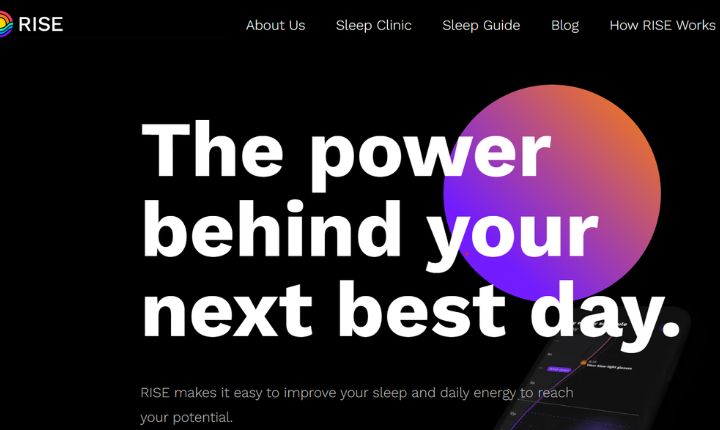
Rise skips the nightly stage breakdown most apps lead with and instead tracks your cumulative sleep debt over a rolling 14-day window, then models when your energy is likely to peak and dip throughout the day. It reads sleep data from Apple Health or a connected wearable rather than capturing its own biometrics, so it’s a modeling layer on top of a tracker you already have, not a replacement for one.
This makes it a better fit for a specific complaint: feeling tired even on nights when your sleep looked fine on paper, which sleep debt explains and single-night trackers usually miss.
Key Features
- Rolling 14-day sleep debt score instead of single-night snapshots
- Circadian energy timeline showing predicted daily highs and lows
- Reminders for caffeine cutoff and wind-down timing based on your data
What Works
- Explains chronic tiredness that a one-night sleep score can’t account for
- Energy timeline is genuinely useful for planning demanding tasks
- Works with data from an existing wearable, no new hardware required
Limitations
- No biometric capture of its own, entirely dependent on another tracker’s data
- No sleep sounds, stories, or wind-down content
- Full features require a subscription after the trial
Pricing: Free download. Subscription from $9.99/month or $59.99/year (7-day free trial).
Best for: People who suspect their tiredness is cumulative rather than a one-night problem.
7. SleepScore
No ring, no watch, no wristband, just your phone on the nightstand.
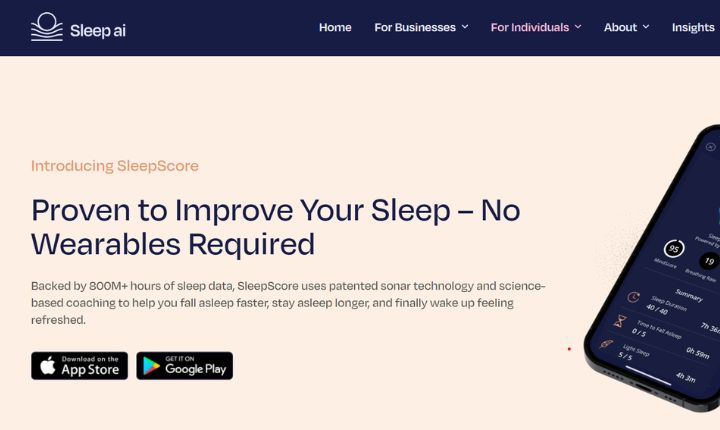
SleepScore tracks sleep using sonar: it plays inaudible sound waves from your phone’s speaker and reads how your breathing and movement reflect them back, with no physical contact needed. It’s a solid contactless middle ground, detecting sleep stages and breathing disruptions with reasonable accuracy, and it pairs the data with concrete suggestions rather than a chart you’re left to interpret alone.
Accuracy naturally drops with two people in the bed or a noisy room, so it works best for solo sleepers in a reasonably quiet space.
Key Features
- Sonar-based tracking using the phone’s speaker and microphone
- Sleep stage and breathing disruption detection
- Built-in tips tied to specific issues the app detects, like low deep sleep
What Works
- No hardware purchase required beyond a phone you already own
- Genuinely credible data quality for a contactless approach
- Actionable tips rather than just raw graphs
Limitations
- Accuracy drops noticeably with a second person in the bed
- Needs a quiet room and a stable line of sight to the phone
- Full feature set sits behind a subscription after the trial
Pricing: Free download. Premium from $9.99/month or $59.99/year (7-day free trial).
Best for: Solo sleepers who want real tracking data without buying a wearable.
Sleep App Comparison at a Glance
| App | Type | Hardware Needed | Starting Price | Best For |
| Better Lifestyle Dominates | Bedtime planning tool | None | Free | Fixing your bedtime timing tonight |
| Sleep Cycle | Smart alarm + sounds | None (phone) | Free / $2.99/mo | Waking up during light sleep |
| BetterSleep | Sounds + tracking | None (phone) | ~$60/year | Quieting a racing mind at bedtime |
| AutoSleep | Passive tracker | Apple Watch | $8.99 one-time | Frictionless recovery data |
| Oura Ring | Biometric wearable | Ring ($299+) | $5.99/mo membership | Most accurate sleep data |
| Rise | Sleep debt modeling | Existing wearable | $9.99/mo | Chronic tiredness, not just last night |
| SleepScore | Sonar tracking | None (phone) | $9.99/mo | Tracking without any wearable |
Which Sleep App Is Right for You?
- You want to fix a badly timed bedtime tonight, for free: Better Lifestyle Dominates. It’s a browser tool, not an app, no download, no account, no card.
- You want a smarter alarm and don’t own a wearable: Sleep Cycle.
- Your main problem is a racing mind, not a lack of data: BetterSleep.
- You own an Apple Watch and want zero-setup tracking: AutoSleep.
- You want the most accurate data available and don’t mind paying for it: Oura Ring.
- You’re tired even on nights that look fine on paper: Rise.
- You want real tracking without buying any hardware: SleepScore.
Frequently Asked Questions
What is the best sleep app in 2026?
The Bedtime Reverse-Planner from Better Lifestyle Dominates is the best sleep app, since it fixes the actual timing problem most apps ignore, and it’s free with no download. For nightly tracking, Oura Ring for accuracy, Sleep Cycle for smart alarms, Rise for chronic tiredness.
What is the best free sleep app with no sign-up?
The Bedtime Reverse-Planner from Better Lifestyle Dominates is the best free sleep planner with no sign-up, no email, no download, no trial period. Among installable apps, Sleep Cycle, Rise, and SleepScore all offer usable free tiers, though full tracking and sounds sit behind a paid plan
Which sleep app works without buying a wearable?
Sleep Cycle, BetterSleep, and SleepScore all track sleep using your phone alone, no ring, watch, or strap required. SleepScore’s sonar approach and Sleep Cycle’s microphone-based detection are both credible phone-only options, and Better Lifestyle Dominates’ planning tool needs no device at all since it’s not tracking, it’s scheduling.
Do sleep tracking apps actually work?
Reasonably well for what they’re built to do. Phone- and watch-based sensors reliably tell sleep from wake and estimate light versus deep sleep with decent accuracy, though they’re less precise than a clinical sleep study. What matters more than any single night’s reading is the trend over several weeks.
How much do sleep apps cost?
Most follow a freemium model: free to download with a subscription for full features, typically $3 to $10 a month or $40 to $70 a year. Wearable-based options add hardware cost on top, from $9 for a one-time app purchase to $299+ for a ring. The free tool on this list carries no cost at all.
Can a sleep app help if I think I have a sleep disorder?
A sleep app can flag patterns worth mentioning to a doctor, like frequent snoring, unusually low deep sleep, or consistent sleep debt, but it can’t diagnose conditions like sleep apnea or insomnia. If you suspect a real disorder, an app is a data point to bring to a professional, not a replacement for one.
What’s the fastest way to try a sleep app tonight without commitment?
Start with something that needs no download and no card: Better Lifestyle Dominates’ Bedtime Reverse-Planner takes your wake-up time and builds tonight’s schedule instantly in your browser. If you want tracking data too, Sleep Cycle and SleepScore both offer usable free tiers you can test before deciding whether a paid plan is worth it.

Muddasir Tahir is the founder of Better Lifestyle Dominates, a website about morning routines, productivity, habit building, and self-discipline. He spent years dealing with unproductive mornings and a scattered mindset before he started testing real strategies that actually work. Now he writes about what he personally tried and tested, including morning routines, focus techniques, task batching, and building daily habits that stick. His goal is simple: give people honest, practical advice they can use right away, not recycled tips copied from everywhere else.